 Ministerie van Volksgezondheid,
Welzijn en Sport
Generic Functions & Patterns - Implementation Guide
0.9.9 - trial-use

Ministerie van Volksgezondheid,Generic Functions & Patterns - Implementation Guide
0.9.9 - trial-use
Generic Functions & Patterns - Implementation Guide - Local Development build (v0.9.9) built by the FHIR (HL7® FHIR® Standard) Build Tools. See the Directory of published versions
Generic Function Addressing (GFA) defines how healthcare parties can publish, discover, and use trusted addressing information for organizations, services, locations, and endpoints. Its purpose is to make healthcare data exchange interoperable and reliable by helping practitioners and systems route requests, referrals, data retrievals and notifications to the correct destination.
This specification is based on the IHE mCSD profile and reuses the actor and transaction definitions that were defined in that specification. You should be able to read this specification without prior knowledge of IHE mCSD, but a basic understanding of the FHIR specification is preferred.
Here is a brief overview of the processes that are involved:
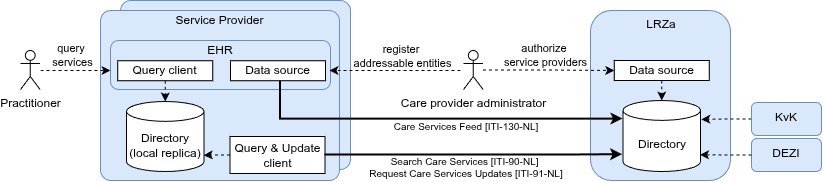
This overview implies a decentralized architecture with local Data Source actors and LRZa Directory replicas. An important central component is the LRZa Administration Directory, but this central component is not a crucial asset at data exchange runtime (only for creating or updating addressable entities). The LRZa Directory periodically imports Organization and Location resources from the KvK and Dezi-registry.
This specification is based on the IHE mCSD profile and constrains and profiles the mCSD specification for the Dutch national context. The following national choices apply:
Data model profiling: The national profiles SHALL be based on NL-core where available and SHALL be aligned with relevant IHE mCSD profile constraints.
LRZa Directory operational role:
The LRZa Directory SHALL NOT support matching of care service entities (e.g. query for a specific type of HealthcareService or Endpoint). Matching SHALL be performed on a local Directory (LRZa replica). The LRZa Directory SHALL act as the central consolidation and distribution point for the directory (a single consolidated view), and SHALL NOT have a direct operational role in healthcare data exchange transactions. For replication purposes, LRZa SHALL support search-type interactions from the mCSD ITI-90 transaction without search parameters for the initial load of the local replica. To bound load and keep operational matching on the replicas, the LRZa Directory SHALL restrict search operations to the minimum required for replication and SHALL apply rate limiting to operational consumers.
Paging and consistent initial load:
For the initial load (ITI-90-NL search-type without search parameters), the LRZa Directory SHALL return results using paging: it SHALL include Bundle.link with relation = next until all results are returned, and SHALL enforce a maximum page size. The maximum page size is advertised by the server and specified in the LRZa SLA. Update Clients SHALL follow next links until exhausted.
To reduce unresolved references during loading, Update Clients SHOULD load resource types in an order where referenced resources generally precede referencing resources (e.g. Organization → Location → HealthcareService → Endpoint → OrganizationAffiliation). Because the data model contains circular references (e.g. Organization.endpoint ↔ Endpoint.managingOrganization), no ordering can guarantee that every reference resolves during loading; this is why the order is SHOULD, not SHALL.
Because the paged initial load is not atomic, the Update Client SHALL take the server time reported in Bundle.meta.lastUpdated of the first page as the sync timestamp — the LRZa server time up to which the replica is in sync — and, once the paged load completes, SHALL perform an incremental history-type synchronization (ITI-91-NL) with _since set to that sync timestamp. Using the LRZa-reported time avoids client/server clock skew, and this captures mutations made during the load without requiring a server-side point-in-time snapshot. How the Update Client retains the sync timestamp is implementation-defined (e.g. a small stored value, or derived from the replica content); because synchronization is processed idempotently, an inclusive _since (re-fetching the boundary resources) is safe.
A Local Replica SHALL accept resources whose references cannot (yet) be resolved and SHALL NOT enforce referential integrity on write during the initial load; without this, replication breaks whenever a delta arrives before the resource it references. A Local Replica SHOULD NOT serve Query Clients until the initial load and the subsequent _history catch-up have completed.
Incremental synchronization (ITI-91-NL) is type-level ({resourceType}/_history, per mCSD ITI-91). Resource types SHOULD be synchronized on a single, common interval rather than per-type intervals: differentiating the interval per resource type would let a referencing resource of a fast-syncing type point at a not-yet-replicated resource of a slow-syncing type for a prolonged period. The LRZa SLA specifies the most frequent interval the Directory accepts (the rate limit), not how often a replica must synchronize; a replica chooses its own interval within that bound, short enough for the timeliness its use case needs. As a non-binding guideline, a synchronization interval of about 15 minutes is advised, which keeps endpoint and routing changes sufficiently fresh for referral and exchange workflows. Because synchronization can run in many decentralized instances, an Update Client SHOULD spread its synchronization moment across the interval (for example by applying a random offset) rather than synchronizing on fixed clock boundaries; this avoids a self-inflicted concurrency peak at the LRZa Directory. Synchronization is delta-based (_history), so a typical round returns a small or empty result and the average load per client is low; the peak driven by simultaneous requests is the relevant concern, which spreading mitigates.
The Update Client SHALL process incremental synchronization strictly sequentially rather than issuing _history requests in parallel: history entries SHALL be applied in chronological order (an older version SHALL NOT overwrite a newer one), and each history-type request (and each page of its response) SHALL complete and be applied before the next is issued. Sequential processing keeps the replica internally consistent, preserves the monotonic _since watermark on which retry depends, and bounds the request rate a single replica places on the LRZa Directory.
In steady state the Update Client therefore runs a simple loop: pull the incremental updates sequentially (advancing the _since watermark), wait for the synchronization interval (about 15 minutes, spread as described above), and repeat.
Concurrency control on updates:
The LRZa Directory SHALL support optimistic locking: it SHALL return an ETag (resource versionId) on read and on create/update responses, and SHALL honour the If-Match header on update interactions, rejecting an update that carries a stale version with HTTP 412 Precondition Failed (the server advertises this through versioning = versioned-update). A Data Source SHALL send If-Match on updates and, on a 412, re-read and re-apply. It prevents silent overwrite where a resource can be mutated through more than one channel (e.g. from CIBG as Data Source with update records from KvK/DEZI and one or more Data Sources). For more info on this topic, see FHIR transactional integrity and FHIR concurrency
Mutation signing (optional):
Digitally signing mutations with a FHIR Provenance resource is currently OPTIONAL. The LRZa Directory SHALL NOT require a digital signature to accept a mutation, and the absence of a Provenance SHALL NOT be a reason for rejection. A Data Source MAY accompany a mutation with a signed Provenance resource that references the stored resource. When a Provenance is present, the LRZa Directory SHALL verify its signature against the relevant trust chain (a Provenance is signed with a PKIoverheid certificate of the organization; a UZI certificate is provisionally allowed on the OrganizationAffiliation mandate) and SHALL reject an invalid signature with an OperationOutcome. Provenance records are stored in the LRZa Directory and synchronized to local replicas (see ITI-90-NL/ITI-91-NL), so that any party that wishes to — replica operators, auditors or supervisors — MAY independently verify the origin and integrity of an accepted mutation without having to trust the LRZa on its word. As a growth path, use of digital signatures may be made mandatory later; see Roadmap. For a worked, step-by-step example of creating and verifying a signature, see Resource signing.
Each actor will now be discussed in more detail.
The LRZa Directory is the central national directory for publishing and distributing addressable entities. It is the authoritative source for nationally governed directory content and provides interfaces for administration and retrieval of updates. The LRZa Directory is not intended for runtime matching in operational healthcare workflows; searching/matching SHALL be performed on local replicas. This Directory provides an API for the 'Data Source' and 'Update Client' that implements these CapabilityStatements:
A Data Source is a client/actor of an authorized party (e.g. an IT vendor or the care provider itself) that publishes and maintains directory entities on behalf of care providers. The Data Source actor SHALL use interactions conforming to CapabilityStatement ITI-130-NL, including create/update for Organization, Location, HealthcareService, and Endpoint.
The Update Client refers to two separate actors defined in IHE mCSD a 'lite version' of the Query Client and the Update Client. These clients are grouped for the Dutch national context. This actor uses the search-type interaction (without search parameters) for the initial load of the local Directory (replica). It also periodically synchronizes from the LRZa Directory to a local replica using history-type interactions and _since parameter to request incremental updates. It consumes search interactions conforming to CapabilityStatement ITI-90-NL and update-oriented interactions defined in CapabilityStatement ITI-91-NL.
The Update Client synchronizes (replicates) directory content; it does not aggregate. Aggregation of source registers and self-registered data is performed centrally by the LRZa Directory. Incremental synchronization SHALL be processed idempotently (re-applying a delta SHALL be safe), and on transient failure the client SHALL retry from the last successfully processed _since watermark.
For more information, see the initial load and incremental sync examples.
The Query Client uses the local replica to find organizations, healthcare services, locations, endpoints, and organizational relationships for routing and discovery. Note that the data exchange between Query Client and (local) Directory MAY use a proprietary interface. Use case 3 and use case 4 illustrate how to search for healthcare services and endpoints.
When selecting an Endpoint for data exchange, the Query Client SHALL only use Endpoints that have status active and whose period, when present, includes the current time. Within that selection, the Query Client matches on connectionType and payloadType (see use case 4). When multiple valid Endpoints remain for the same Organization or HealthcareService and the same connectionType/payloadType combination, this indicates either intentional redundancy (multiple endpoints due to different software systems) or a registration error.
Note: FHIR R4 does not define a search parameter for Endpoint.period, so the period is evaluated by the Query Client after retrieving candidate Endpoints from the local replica.
Transactions between Service Providers and the LRZa are defined here. Other (local or 3rd party) transactions are not specified here. These transactions MAY reuse/adopt IHE mCSD and FHIR transactions, but are not obliged.
The Data Source publishes entities to the LRZa Directory using create/update semantics as profiled in the Data Source capability statement. Submitted resources SHALL be validated against the applicable NL-GF profile; invalid resources SHALL be rejected with an OperationOutcome. Resources SHOULD not be deleted; withdrawal SHOULD be expressed through a status change. Updates SHALL use optimistic locking (If-Match), which the server supports (see "Concurrency control on updates"). Resources may be published individually or in a transaction (all-or-nothing). A Data Source MAY additionally submit a signed Provenance referencing the stored resource; this is optional, see Resource signing.
CapabilityStatement: ITI-130-NL
The Update Client loads/queries directory data for initial population of the local replication using search-type interactions without search parameters. The initial load is paged (see National Constraint "Paging and consistent initial load").
CapabilityStatement: ITI-90-NL
The Update Client retrieves changes from the LRZa Directory using history-type interactions per supported resource, optionally constrained by _since for incremental synchronization.
CapabilityStatement: ITI-91-NL
All transactions SHALL return a standard FHIR OperationOutcome with an appropriate HTTP status code (e.g. 400 malformed request, 412 stale version on a concurrent update, 422 profile validation failure, 429 too many requests when rate limiting applies, 5xx server error). Clients (Data Source, Update Client) SHALL implement retry with exponential backoff for transient failures (5xx, network) and SHALL process synchronization idempotently. When the LRZa Directory applies rate limiting and responds with 429 Too Many Requests, the client SHALL honor the Retry-After header where present and back off before retrying, rather than retrying immediately. A Query Client reads whatever the local replica currently holds; it cannot itself resolve staleness and relies on the Update Client's next synchronization to bring in newer data. Where a workflow cannot tolerate the replica's bounded staleness for a critical decision, the consuming application verifies the relevant information out of band (e.g. directly against the addressed party) rather than treating the directory as authoritative for that decision.
Within GF Addressing, several addressable entities are used to capture and publish information. An overview of the most common elements and relations between entities:
erDiagram
    HealthcareService }o--|| Organization : providedBy
    HealthcareService }o--o{ Location : location
    HealthcareService }o--o{ Endpoint : endpoint
    Location }o--|| Organization : managingOrganization
    Organization }o--o{ Endpoint : endpoint
    Endpoint }o--|| Organization : managingOrganization
    OrganizationAffiliation }o--|| Organization : organization
    OrganizationAffiliation }o--|| Organization : participatingOrganization

    HealthcareService {
        providedBy Reference  "1..1"
        type CodeableConcept "1..*"
        supportedActivityDefinitions Reference "0..*"
        specialty CodeableConcept "0..*"
        name string  "0..1"
        telecom ContactPoint  "0..*"
        location Reference  "0..*"
        availableTime Availability  "0..*"
        endpoint Reference  "0..*"
    }

    Location {
        name string  "0..1"
        alias string  "0..*"
        address Address  "0..1"
        managingOrganization Reference  "1..1"
        partOf Reference  "0..1 (parent Location)"
    }

    Organization {
        identifier Identifier  "0..1"
        type CodeableConcept  "1..*"
        name string  "1..1"
        alias string  "0..*"
        telecom ContactPoint  "0..*"
        partOf Reference  "0..1 (parent Organization)"
        endpoint Reference  "0..*"
    }

    Endpoint {
        status code  "1..1"
        connectionType Coding  "1..1"
        payloadType CodeableConcept  "1..*"
        address url  "1..1"
    }

    OrganizationAffiliation {
        organization Reference  "1..1"
        participatingOrganization Reference  "1..1"
        code CodeableConcept  "1..*"
    }
A brief description of the entities:
Healthcare services are used to publish which (medical) services are provided by a (child) Organization at some Location(s). Examples include surgical services, antenatal care services, or primary care services. These services in HealthcareService.type can be extended by references to specific ActivityDefinitions and PlanDefinitions that are supported. The combination of a HealthcareService offered at a Location may have specific attributes including contact person, hours of operation, etc. Typically, HealthcareServices use Endpoints that support receiving notifications or requests.
The NL-GF-HealthcareService profile is used to represent healthcare service offerings.
Key attributes:
| Attribute | Card. | Description |
|---|---|---|
| identifier (CustodianAssignedIdentifier) | 1..1 | identifier for provenance and traceability. |
| providedBy → Organization | 1..1 | The organization that provides this service. |
| type | 1..* | The type of service (required binding to NL-GF Service Types, including procedure and care-type codesystems in CBV, DHD, Geboortezorg, GGZ, NHG, NZa and WLZ). |
| type.supportedActivityDefinitions | 0..* | References to ActivityDefinitions or PlanDefinitions specifying the service type further. |
| specialty | 0..* | The specialty of the service (required binding). |
| name | 0..1 | A human-readable name for the service. |
| telecom | 0..* | Contact details for the service. |
| location → Location | 0..* | The location(s) where this service is available. |
| availableTime | 0..* | Times the service is available. |
| endpoint → Endpoint | 0..* | Technical endpoints for notifications or requests. |
Organizations are “umbrella” entities; these may be considered the administrative bodies under whose auspices care services are provided. Typically, (top-level)Organization-instances use Endpoints that publish healthcare data for other (healthcare) organizations to query. Departments of an institution, or other administrative units, may be represented as child Organizations of a parent Organization. The NL-GF-Organization profile is used to represent organizations and their hierarchical relations in this guide. Key attributes:
| Attribute | Card. | Description |
|---|---|---|
| identifier (URA or KVK) | 0..* | An Organization SHALL have a URA identifier, or be partOf another Organization. |
| type | 1..* | Type of organization, including an SBI (Standaard Bedrijfsindeling) code (extensible binding to NL-GF Organization Types). |
| name | 1..1 | The name of the organization. |
| alias | 0..* | Alternative names. |
| telecom | 0..* | Contact details. |
| partOf → Organization | 0..1 | The parent organization (for departments or sub-units). |
| endpoint → Endpoint | 0..* | Technical endpoints used by this organization. |
An addressable entity may be reachable for electronic data exchange through electronic Endpoint(s). An Endpoint may be a FHIR server, a DICOM web service, OAuth token endpoint, or some other mechanism. Typically, Organizations and HealthcareServices refer to Endpoints. This relationship is meant to indicate that, e.g., a care provider (Organization) uses an Endpoint. An Endpoint also refers to one specific organization that manages the Endpoint (e.g. IT vendor); this is not the organization using the endpoint. The NL-GF-Endpoints profile is used to represent electronic access points for data exchange. Key attributes:
| Attribute | Card. | Description |
|---|---|---|
| status | 1..1 | The operational status of the endpoint (e.g. active, off). |
| period | 0..1 | The interval during which the endpoint is expected to be operational. An absent period.end means the endpoint is operational until further notice. |
| connectionType | 1..1 | The type of connection (extensible binding to Core connection types and NL-GF Connection Types). |
| payloadType | 1..* | The payload type(s) supported (extensible binding to NL-GF Payload Types). |
| payloadMimeType | 0..* | The mime type(s) of the payload, including the standard version for FHIR endpoints (e.g. application/fhir+json; fhirVersion=4.0). |
| address | 1..1 | The technical address (URL) of the endpoint. |
| managingOrganization → Organization | 1..1 | The organization that manages this endpoint (e.g. IT vendor). |
The purpose of an Endpoint in this directory is discovery: it tells a system where a service can be reached and which technical protocol and payload to use (connectionType, payloadType, payloadMimeType, address). The terms of use, authentication requirements and security requirements that apply when actually invoking an Endpoint are determined by the trust framework ("afsprakenstelsel") within which the exchange takes place, not by the directory entry. Registering Endpoints centrally is valuable precisely because it makes them discoverable across trust frameworks and use cases, independent of conditions that govern their use.
The directory therefore does not carry per-Endpoint terms of use, authentication or security policy. Transport security for publishing to the LRZa Directory is covered under Security; the broader authentication and security requirements for invoking endpoints are addressed in the dedicated security and authentication tracks (see epics security (#854) and authentication means (#855)).
Systems may support multiple versions of a standard at the same time, for instance during the transition from FHIR STU3 to FHIR R4 (zib2017 to zib2020). The version of the standard is therefore part of the selection criteria for an Endpoint and is expressed machine-readably in payloadMimeType:
connectionType (e.g. hl7-fhir-rest) SHALL include the FHIR version in its payloadMimeType values, using the standard fhirVersion MIME-type parameter: application/fhir+json; fhirVersion=4.0 (R4) or application/fhir+json; fhirVersion=3.0 (STU3).payloadMimeType values on a single Endpoint. A future payload version migration therefore does not require registering a new Endpoint; separate Endpoints are only needed when the versions are served on different addresses.connectionType, payloadType and — when the payload version matters for the exchange — payloadMimeType including its fhirVersion parameter.Endpoint.name MAY mention a version for readability, but systems SHALL NOT rely on free-text fields for version selection; payloadMimeType is the normative source.The Directory only carries the metadata needed for selecting an Endpoint (connectionType, payloadType, payloadMimeType). How detailed conformance information is obtained depends on the connection type:
[address]/metadata.formatCode in the document metadata), not per Endpoint.An Endpoint's validity can expressed through status and period:
status describes the operational state of the endpoint itself (active, suspended, off, entered-in-error).period describes the interval during which the endpoint is expected to be operational. An Endpoint without period.end is operational until further notice. A period.start in the future MAY be used to announce an endpoint ahead of its activation; no separate scheduling mechanism is provided.When a care provider migrates to another system, the Endpoints of the old and the new system may be registered simultaneously, but their periods SHALL be set such that at most one of them is valid at any moment: the superseded Endpoint receives a period.end at the planned cutover moment and the replacing Endpoint a period.start at that same moment. This removes any ambiguity about which Endpoint to use during a transition: data exchange partners select the Endpoint whose period includes the current time (see Query Client). When a single Data Source is authorized for both changes, it SHOULD apply them atomically in one FHIR transaction Bundle. When two different service providers are involved, both can safely register their change ahead of the cutover moment, because Endpoint selection is driven by period, not by registration time.
After the old system has actually been taken out of operation, its Endpoint status SHOULD be set to off or deleted.
Use case 5 illustrates a transition between systems.
Locations are physical places where care can be delivered such as buildings (NL: Vestiging), wards, rooms, or vehicles. A Location may have geographic attributes (address, geocode), attributes regarding its hours of operation, etc. Each Location is related to one Organization. A location may have a hierarchical relationship with other locations (e.g. building > floor > room). The NL-GF-Location profile is used to represent physical care-delivery locations. Key attributes:
| Attribute | Card. | Description |
|---|---|---|
| identifier (CustodianAssignedIdentifier) | 1..1 | identifier for provenance and traceability. |
| name | 1..1 | The name of the location. |
| type | 1..1 | The type of location. |
| status | 1..1 | The operational status (e.g. active, inactive). |
| address | 0..1 | The physical address. |
| managingOrganization → Organization | 1..1 | The organization responsible for this location. |
| partOf → Location | 0..1 | The parent location (e.g. building → floor → room). |
OrganizationAffiliation resources are used to represent relationships between organizations, primarily a software vendor managing the Endpoint that is used by a care provider. The LRZa Directory uses OrganizationAffiliations to authorize incoming create and update interactions of service providers. It could also be used to represent multiple care providers working together under some agreement (e.g. in a region). The NL-GF-OrganizationAffiliation profile is used to represent organizational relationships in this guide. Key attributes:
| Attribute | Card. | Description |
|---|---|---|
| active | 1..1 | Whether this affiliation is currently active. |
| organization → Organization | 1..1 | The care provider organization. |
| participatingOrganization → Organization | 1..1 | The affiliated party (e.g. IT vendor). |
| code | 1..* | The type of affiliation (required binding to NL-GF Authorization Types). |
A Provenance resource records the origin and (optionally) a digital signature of a mutation submitted to the LRZa Directory. Signing is optional; when present, a Provenance makes the origin and integrity of an accepted mutation independently verifiable by the LRZa Directory, local replicas, auditors and supervisors. A Provenance references the stored version of the mutated resource and carries a signature computed over the canonical JSON form of that resource. See the signed Provenance example for an OrganizationAffiliation mandate, and the Resource signing page for the step-by-step derivation of its signature. Key attributes:
| Attribute | Card. | Description |
|---|---|---|
| target → (mutated resource) | 1..* | A reference(s) to the stored resource this Provenance covers (e.g. OrganizationAffiliation/{id}). |
| recorded | 1..1 | The instant the Provenance record was created. |
| agent.type | 0..1 | Role of the agent, e.g. author from the provenance participant type code system. |
| agent.who → Organization | 1..1 | The organization responsible for the mutation (the care provider for an OrganizationAffiliation mandate, or the authorized Data Source for other mutations). |
| signature.type | 1..* | The signature purpose, from urn:iso-astm:E1762-95:2013 (e.g. 1.2.840.10065.1.12.1.1 "Author's Signature"). |
| signature.when | 1..1 | The instant the signature was created. |
| signature.who → Organization | 1..1 | The signer. For an OrganizationAffiliation mandate this is the care provider (certificate: UZI or PKIoverheid); for other mutations the authorized Data Source (PKIoverheid). |
| signature.targetFormat | 0..1 | The mime type of the signed content: application/fhir+json;canonicalization=http://hl7.org/fhir/canonicalization/json#static. |
| signature.sigFormat | 0..1 | The mime type of the signature itself: application/jose (a detached JWS). |
| signature.data | 1..1 | The base64-encoded detached JWS signature. |
The signature is computed over the canonical JSON form of the referenced resource, using canonicalization type http://hl7.org/fhir/canonicalization/json#static. This is the FHIR static JSON canonicalization: it fixes element ordering to the order defined by the specification and removes insignificant whitespace, so that a replica, auditor or supervisor can reproduce the exact byte sequence that was signed and verify the signature independently. Fixing the canonicalization method is what makes the signature verifiable across parties; both signer and verifier SHALL apply http://hl7.org/fhir/canonicalization/json#static before, respectively, computing and checking the detached JWS carried in signature.data.
The data model of the IHE mCSD contains resourcetypes/profiles for Practioner and PractitionerRole. These entities are NOT in scope of the Generic Function Addressing. The main reason is that there is currently no legal basis for the processing of data of healthcare professionals by the 'Landelijk Register Zorgaanbieders' (LRZa).
A Data Source actor SHALL use mTLS for transport layer security. Qualified certificates from Qualified Trusted Service Providers (like PKIoverheid) should be trusted. (GF-Adressering, ADR#178).
The LRZa-Directory SHALL only support creation/updates of OrganizationAffiliations by Care Providers, not by the parties that are being authorized (the .participatingOrganization).
Beyond transport security, mutations MAY be signed at record level with a FHIR Provenance resource (see National Constraint "Mutation signing (optional)"). Signing is currently not mandatory: the LRZa Directory accepts mutations without a Provenance. When a Provenance is present, the LRZa Directory SHALL verify its signature, and parties that wish to (replica operators, auditors, supervisors) MAY verify it as well. A Provenance is signed with a PKIoverheid certificate of the organization; because not every care provider holds a PKIoverheid certificate, a UZI certificate is provisionally allowed for signing the Provenance on the OrganizationAffiliation (the mandate expressing which Data Source may mutate on behalf of which care provider). This makes the provenance chain of each accepted record independently verifiable and detectable across the whole system, without introducing a new certificate chain. The Resource signing page gives a worked example of how such a signature is created and verified.
This sequence shows a two-step onboarding flow: first, the care provider administrator creates an OrganizationAffiliation that authorizes the service provider. After this authorization exists, the service provider is able to register their Endpoints (if not already registered). Finally, the care provider administrator is able to register and update the remaining mCSD resource types in the application of the service provider (e.g. the EHR).
sequenceDiagram
    actor Admin as Care provider<br/>administrator
    actor SPAdmin as Service Provider<br/>administrator
    participant SP as Service Provider<br/>(Data Source)
    participant DSAdmin as LRZa Portal<br/>(Data Source)
    participant LRZa as LRZa Directory

    activate Admin
    activate DSAdmin
    Admin->>DSAdmin: Register authorization for IT vendor
    activate LRZa
    DSAdmin->>LRZa: POST /OrganizationAffiliation<br/>(organization,<br/>participatingOrganization, code)
    LRZa-->>DSAdmin: 201 Created
    DSAdmin-->>Admin: Authorization active
    deactivate DSAdmin

    Note over Admin,LRZa: After affiliation is active

    activate SPAdmin
    activate SP
    SPAdmin->>SP: Register new endpoints for EHR system
    SP->>LRZa: POST /Endpoint
    Note right of SP: If the endpoints were already registered<br/>for other care providers, these Endpoint<br/>updates can be skipped.
    deactivate SPAdmin
    Admin->>SP: Link endpoints to organization
    SP->>LRZa: PUT /Organization/ura-123
    Admin->>SP: Register new location
    SP->>LRZa: POST /Location
    Admin->>SP: Register new healthcare service<br/>with links to location and endpoints
    SP->>LRZa: POST /HealthcareService
    Note over LRZa: Authorization checks are based on<br/>OrganizationAffiliation and requested scope.
    deactivate SP
    deactivate LRZa
    deactivate Admin
The following sequence diagram illustrates how an Update Client performs the paged initial load of a local replica, records the sync timestamp, and runs a _history catch-up before serving Query Clients:
sequenceDiagram
    participant QD as Directory<br/>(local replica)
    participant QUC as Query and Update<br/>Client
    participant LRZa as LRZa Directory

    activate QUC
    Note over QUC: Initial load — replica state: LOADING
    loop For each resource type (in recommended order)
        QUC->>LRZa: GET /{resourceType}
        activate LRZa
        LRZa-->>QUC: Bundle (searchset, page 1)<br/>Bundle.meta.lastUpdated = T0
        Note over QUC: Keep T0 as sync timestamp<br/>(LRZa time, from first page, once)
        QUC->>QD: persist page (batch/upsert)
        activate QD
        QD-->>QUC: 200 OK
        deactivate QD
        loop While Bundle.link[next] present
            QUC->>LRZa: GET {next}
            LRZa-->>QUC: Bundle (searchset, next page)
            QUC->>QD: persist page (batch/upsert)
            activate QD
            QD-->>QUC: 200 OK
            deactivate QD
        end
        deactivate LRZa
    end
    Note over QUC,QD: Pages are streamed: each page is written<br/>before the next is fetched.

    Note over QD,LRZa: Catch-up for mutations<br/>during the (non-atomic) load
    loop For each resource type
        QUC->>LRZa: GET /{resourceType}/_history?_since=T0
        activate LRZa
        LRZa-->>QUC: Bundle (history delta)
        deactivate LRZa
        QUC->>QD: persist delta (batch/upsert)
        activate QD
        QD-->>QUC: 200 OK
        deactivate QD
    end
    Note over QUC,QD: Initial load complete. Replica state: READY.<br/>Retain sync timestamp for next sync.
    deactivate QUC
The following sequence diagram illustrates the periodic incremental synchronization, including delta processing, status changes, retry on transient failure, and advancing the sync timestamp:
sequenceDiagram
    participant QD as Directory<br/>(local replica)
    participant QUC as Query and Update<br/>Client
    participant LRZa as LRZa Directory

    Note over QUC: Periodic incremental sync<br/>(single interval for all resource types — see SLA)
    activate QUC
    loop For each resource type
        QUC->>LRZa: GET /{resourceType}/_history?_since={sync ts}
        activate LRZa
        alt success
            LRZa-->>QUC: Bundle (history delta) incl. status changes<br/>(inactive / off / entered-in-error)
        else transient failure (5xx / network)
            LRZa-->>QUC: error
            Note over QUC: Retry with exponential backoff from the<br/>same {sync ts} (do not advance the timestamp)
        end
        deactivate LRZa
    end
    QUC->>QD: persist delta (batch/upsert)
    activate QD
    QD-->>QUC: 200 OK
    deactivate QD
    Note over QUC,QD: Sync complete.<br/>Advance sync timestamp to {sync ts}
    deactivate QUC
The following sequence diagram illustrates the recommended optimistic-locking flow when a Data Source updates a resource: it reads the current ETag, sends the update with If-Match, and — if another writer advanced the version first — receives 412 Precondition Failed, then re-reads and retries:
sequenceDiagram
    participant DS as Data Source
    participant LRZa as LRZa Directory

    Note over DS,LRZa: Optimistic locking on update
    DS->>LRZa: GET /Organization/123
    activate LRZa
    LRZa-->>DS: 200 OK, ETag W/"3"
    deactivate LRZa
    Note over DS: Prepare update based on version 3
    DS->>LRZa: PUT /Organization/123, If-Match W/"3"
    activate LRZa
    alt current version is still 3
        LRZa-->>DS: 200 OK, ETag W/"4"
        Note over DS: Update applied
    else another writer advanced it to 4 first
        LRZa-->>DS: 412 Precondition Failed (OperationOutcome)
        deactivate LRZa
        Note over DS: Re-read, re-base the change<br/>on the latest version, retry
        DS->>LRZa: GET /Organization/123
        activate LRZa
        LRZa-->>DS: 200 OK, ETag W/"4"
        deactivate LRZa
        DS->>LRZa: PUT /Organization/123, If-Match W/"4"
        activate LRZa
        LRZa-->>DS: 200 OK, ETag W/"5"
        deactivate LRZa
    end
The patient, Vera Brooks, consults with her physician who recommends surgery. The physician can assist the patient in finding a suitable care provider, taking into consideration the location and specialty for orthopedic surgeons.
sequenceDiagram
    actor Patient as Vera
    actor Doctor as Dr. West
    participant EHR as EHR (Query Client)
    participant CSD as Directory<br/>(local replica)

    activate Patient
    activate Doctor
    Patient->>Doctor: My knee hurts
    Doctor->>Doctor: diagnosis = torn ACL
    activate EHR
    Doctor->>EHR: use EHR's custom query tool,<br/>search for orthopedic services,<br/>within 30km of Vera's home
    activate CSD
    EHR->>CSD: Find Matching Care Services request<br/>GET [base]/HealthcareService?<br/>type=consultation&specialty=orthopedics
    CSD-->>EHR: response
    EHR->>CSD: Get (parent) Organizations and Locations<br/>for HealthcareServices<br/>GET /Organization/[id], GET /Location/[id], etc
    CSD-->>EHR: response
    EHR->>EHR: Filter results on distance to Vera's home
    deactivate CSD
    EHR-->>Doctor: Review results<br/>with office address, hours of operation
    Doctor-->>Patient: Review and discuss options
    deactivate Patient
    deactivate Doctor
    deactivate EHR
Dr. West just created a referral (for patient Vera Brooks from use case #3). The EHR has to notify Hospital East and the Orthopedic department of this referral. This may include some recurring requests:
sequenceDiagram
    actor Doctor as Dr. West
    participant EHR as EHR
    participant CSD as Directory<br/>(local replica)
    participant EHR2 as Endpoint supporting<br/>Transfer of care<br/>@Hospital East

    activate Doctor
    activate EHR
    rect rgb(238, 242, 245)
        Note over Doctor,EHR: create referral
        Doctor->>EHR: create referral for Dr. East<br/>for Orthopedic department at Hospital East
    end
    activate CSD
    EHR->>CSD: Find HealthcareService of Orthopedic<br/>department including Endpoints<br/>GET /HealthcareService/[id], GET /Endpoint/[id]
    EHR->>EHR: Check Endpoints for 'Transfer of care' support
    deactivate CSD
    EHR-->>Doctor: If no endpoint found: Use other means to send referral
    deactivate Doctor
    activate EHR2
    EHR->>EHR2: Post notification to Endpoint<br/>of Hospital East with referral ID
    deactivate EHR
    deactivate EHR2
The general practice from use case #1 replaces its EHR system and plans a cutover moment at which the new system takes over:
period.start set to the cutover moment.period.end at the same cutover moment — applied by the currently authorized service provider, or combined with the previous step in one transaction Bundle when a single Data Source is authorized for both changes.off.sequenceDiagram
actor Admin as Care provider<br/>administrator
participant SPNew as New EHR<br/>(Data Source B)
participant SPOld as Old EHR<br/>(Data Source A)
participant LRZa as LRZa Directory
participant Replica as Directory<br/>(local replica)
participant QC as EHR at other<br/>care provider<br/>(Query Client)
Note over Admin,QC: In this example the practice plans the cutover<br/>to the new EHR at 2024-01-15.
Note over Admin,QC: Before cutover (2024-01-15)
activate Admin
Admin->>SPNew: Prepare migration to new EHR
activate SPNew
SPNew->>LRZa: POST /Endpoint<br/>(status=active, period.start=2024-01-15)
activate LRZa
deactivate SPNew
Admin->>SPOld: End usage per 2024-01-15
activate SPOld
SPOld->>LRZa: PUT /Endpoint/[old]<br/>(period.end=2024-01-15)
deactivate SPOld
deactivate Admin
Note right of LRZa: Both Endpoints are registered, but their periods<br/>do not overlap: at any moment at most one Endpoint<br/>is valid. If one Data Source is authorized for both<br/>changes, they SHOULD be combined in a single<br/>transaction Bundle.
Replica->>LRZa: Sync updates (ITI-91)
activate Replica
deactivate LRZa
QC->>Replica: Find Endpoints of the practice
activate QC
QC->>QC: Filter: status=active and<br/>period includes now → old Endpoint
Note over Admin,QC: After cutover (2024-01-15)
QC->>Replica: Find Endpoints of the practice
QC->>QC: Filter: status=active and<br/>period includes now → new Endpoint
deactivate QC
deactivate Replica
Note over Admin,QC: After decommissioning the old system
SPOld->>LRZa: PUT /Endpoint/[old] (status=off)
Provenance) is currently optional; making it mandatory will hardening security and trustworthiness of the data